> ## Documentation Index
> Fetch the complete documentation index at: https://newscatcherinc-docs.mintlify.site/docs/llms.txt
> Use this file to discover all available pages before exploring further.
# Location detection methods
> Understand how Local News API uses different methods to detect and validate location mentions in news articles, helping you filter and interpret location-specific content.
## Overview
Local News API provides access to news articles that have been pre-processed to
recognize and validate location mentions. The API uses six distinct ways to
detect locations in articles, allowing you to filter results based on how
confidently a location was identified.
When you search for location-specific news, you can specify which detection
methods to include in your results. This gives you control over the
precision-recall tradeoff in your location-based queries.
If you don't specify detection methods in your request, the response includes
articles found using any available method for your subscription plan. Locations
are provided along with detection methods, helping you understand how the
particular location was identified.
## How location detection works
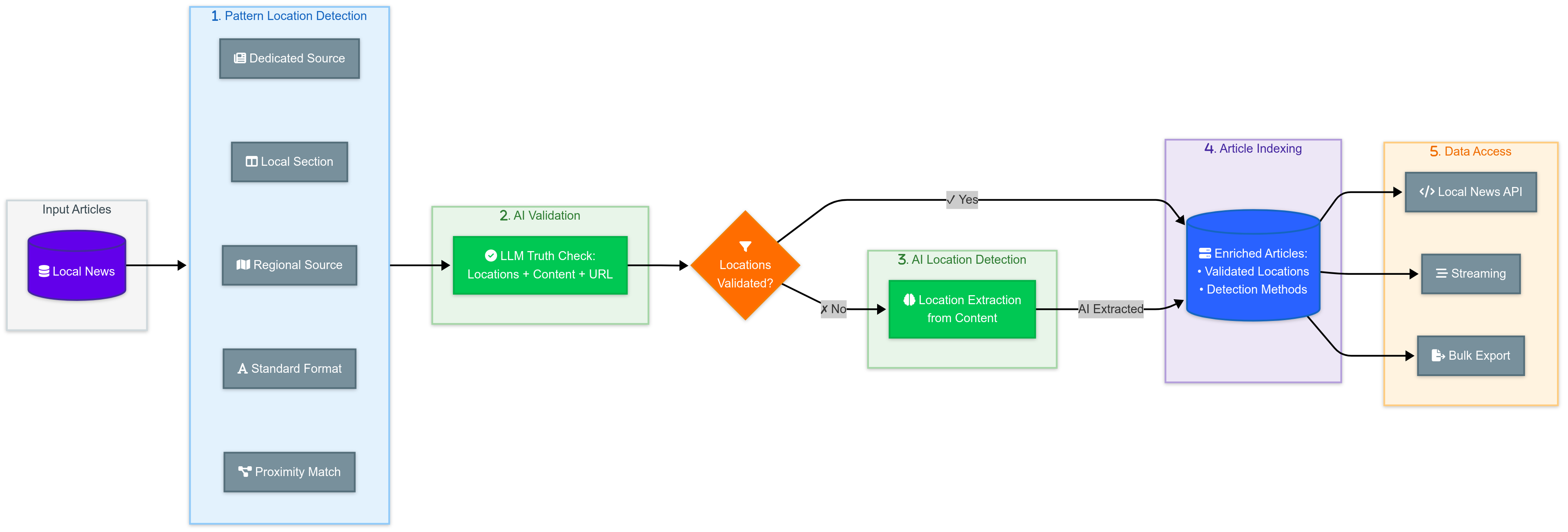 Before being available through the API, articles go through a multi-stage
processing pipeline:
1. The system analyze articles using pattern-based detection methods (dedicated
source, local section, regional source, standard format, and proximity
mention).
2. Detected locations go through AI validation to confirm their relevance to the
article.
3. If no locations are validated in step 2, the AI-based detection method
analyzes the article content to extract locations.
4. Articles are indexed with their validated locations and the detection methods
that identified them.
5. The API provides filtered access to this pre-processed dataset, allowing you
to query by location and specific detection methods.
## Detection methods
### Default behavior
When making API requests, if you don't specify detection methods, the API
includes results from all methods available in your subscription plan. This
means even if you only provide a location parameter, the API returns articles
where that location was identified by any available method.
All detection methods undergo AI validation to ensure accuracy, regardless of
which methods you choose to filter by.
### Dedicated source detection
API method name: `dedicated_source` (US only)
The most precise method for identifying location-relevant content. This method
tags articles from news sources that exclusively cover a specific location, such
as city newspapers or local news websites.
For example, articles from the Fresno Bee are likely relevant to Fresno because
that's their primary coverage area. These sources may reference local landmarks
or community events without explicitly naming the city, but the content is still
reliably location-specific.
**When to use**: Choose this method when you need high-precision results and
work with content from well-known local publications.
**Example sources**:
* City newspapers (San Francisco Chronicle)
* University news portals (Fresno State News)
* Local government news sites
### Local section detection
API method name: `local_section`
This method identifies locations through dedicated local sections within larger
news publications. Many regional and national outlets have local sections that
cover specific geographic areas.
For example, an article from the "Huntington Beach" section of the Orange County
Register is likely relevant to Huntington Beach, even if the city isn't
repeatedly mentioned in the text.
**When to use**: Ideal for finding location-specific content from established
regional publications with dedicated local coverage sections.
### Regional source detection
API method name: `regional_source` (US only)
This method uses the geographic context of news sources to properly interpret
and disambiguate location mentions. It's particularly useful for handling cases
where location names might be ambiguous or where regional context provides
important meaning.
For example, an article from a Texas publication mentioning "Austin" would be
correctly identified as referring to Austin, Texas, rather than Austin in other
states.
**When to use**: Helpful when working with content from sources that cover
multiple locations within a region, or when you need to disambiguate common
location names.
### Standard format detection
API method name: `standard_format`
This method identifies locations written in standard formats such as "City,
State" or "City, Region". It's effective for formal news articles that use
conventional location naming.
For example, mentions like "San Francisco, California" or "Toronto, Ontario" are
captured through this method.
**When to use**: Effective for formal news content and when you want to capture
explicitly formatted location references.
### Proximity mention detection
API method name: `proximity_mention`
This method identifies cases where a city and its state appear within 15 words
of each other, capturing more natural writing patterns.
For example, in the sentence "New development in San Francisco draws attention
across California," the proximity of "San Francisco" to "California" helps
confirm the location reference.
**When to use**: Helpful for finding location mentions in naturally written
content where formal city-state formats aren't used.
The `dedicated_source` and `regional_source` detection methods are only
available for US locations.
### AI-based detection
API method name: `ai_extracted`
This method serves as a secondary extraction layer for articles where
traditional pattern-based detection methods don't yield validated locations. It
uses state-of-the-art large language models to analyze article content and
extract location mentions, even when they're implicit or contextual.
The AI-based detection process works differently from other methods:
1. It processes articles that failed validation in the pattern-based detection
pipeline
2. It analyzes the full article content without relying on predefined patterns
3. It can identify locations mentioned through landmarks, regional terms, or
other indirect references
**When to use**: Particularly valuable for:
* Articles with complex or implicit location references
* Content mentioning local landmarks without explicitly naming cities
* Regional coverage that assumes a local context
* Comprehensive searches where maximum location coverage is important
The `ai_extracted` method is only available with the AI Extraction plan and
provides additional coverage beyond what pattern-based methods can identify.
## Choosing detection methods
When deciding which detection methods to use, consider the following criteria:
* Dedicated source and local section detection provide the highest confidence.
* Standard format detection offers good precision for explicit mentions.
* Proximity mention detection works well for natural writing styles.
* AI-based detection helps with complex or implicit references.
* Use standard format detection for formal news articles.
* Consider proximity mention detection for feature articles.
* Enable AI detection for articles with complex location context.
* Combine multiple methods when source context is important.
* Start with more specific methods if precision is crucial.
* Add broader methods when recall is important.
* Use AI detection for comprehensive coverage.
* Consider your plan's available methods.
## See also
* [Quickstart guide](/local-news-api/get-started/quickstart)
* [API reference](/local-news-api/api-reference/search/search-articles-post)
* [GeoNames filtering](/local-news-api/guides-and-concepts/geonames-filtering)
Before being available through the API, articles go through a multi-stage
processing pipeline:
1. The system analyze articles using pattern-based detection methods (dedicated
source, local section, regional source, standard format, and proximity
mention).
2. Detected locations go through AI validation to confirm their relevance to the
article.
3. If no locations are validated in step 2, the AI-based detection method
analyzes the article content to extract locations.
4. Articles are indexed with their validated locations and the detection methods
that identified them.
5. The API provides filtered access to this pre-processed dataset, allowing you
to query by location and specific detection methods.
## Detection methods
### Default behavior
When making API requests, if you don't specify detection methods, the API
includes results from all methods available in your subscription plan. This
means even if you only provide a location parameter, the API returns articles
where that location was identified by any available method.
All detection methods undergo AI validation to ensure accuracy, regardless of
which methods you choose to filter by.
### Dedicated source detection
API method name: `dedicated_source` (US only)
The most precise method for identifying location-relevant content. This method
tags articles from news sources that exclusively cover a specific location, such
as city newspapers or local news websites.
For example, articles from the Fresno Bee are likely relevant to Fresno because
that's their primary coverage area. These sources may reference local landmarks
or community events without explicitly naming the city, but the content is still
reliably location-specific.
**When to use**: Choose this method when you need high-precision results and
work with content from well-known local publications.
**Example sources**:
* City newspapers (San Francisco Chronicle)
* University news portals (Fresno State News)
* Local government news sites
### Local section detection
API method name: `local_section`
This method identifies locations through dedicated local sections within larger
news publications. Many regional and national outlets have local sections that
cover specific geographic areas.
For example, an article from the "Huntington Beach" section of the Orange County
Register is likely relevant to Huntington Beach, even if the city isn't
repeatedly mentioned in the text.
**When to use**: Ideal for finding location-specific content from established
regional publications with dedicated local coverage sections.
### Regional source detection
API method name: `regional_source` (US only)
This method uses the geographic context of news sources to properly interpret
and disambiguate location mentions. It's particularly useful for handling cases
where location names might be ambiguous or where regional context provides
important meaning.
For example, an article from a Texas publication mentioning "Austin" would be
correctly identified as referring to Austin, Texas, rather than Austin in other
states.
**When to use**: Helpful when working with content from sources that cover
multiple locations within a region, or when you need to disambiguate common
location names.
### Standard format detection
API method name: `standard_format`
This method identifies locations written in standard formats such as "City,
State" or "City, Region". It's effective for formal news articles that use
conventional location naming.
For example, mentions like "San Francisco, California" or "Toronto, Ontario" are
captured through this method.
**When to use**: Effective for formal news content and when you want to capture
explicitly formatted location references.
### Proximity mention detection
API method name: `proximity_mention`
This method identifies cases where a city and its state appear within 15 words
of each other, capturing more natural writing patterns.
For example, in the sentence "New development in San Francisco draws attention
across California," the proximity of "San Francisco" to "California" helps
confirm the location reference.
**When to use**: Helpful for finding location mentions in naturally written
content where formal city-state formats aren't used.
The `dedicated_source` and `regional_source` detection methods are only
available for US locations.
### AI-based detection
API method name: `ai_extracted`
This method serves as a secondary extraction layer for articles where
traditional pattern-based detection methods don't yield validated locations. It
uses state-of-the-art large language models to analyze article content and
extract location mentions, even when they're implicit or contextual.
The AI-based detection process works differently from other methods:
1. It processes articles that failed validation in the pattern-based detection
pipeline
2. It analyzes the full article content without relying on predefined patterns
3. It can identify locations mentioned through landmarks, regional terms, or
other indirect references
**When to use**: Particularly valuable for:
* Articles with complex or implicit location references
* Content mentioning local landmarks without explicitly naming cities
* Regional coverage that assumes a local context
* Comprehensive searches where maximum location coverage is important
The `ai_extracted` method is only available with the AI Extraction plan and
provides additional coverage beyond what pattern-based methods can identify.
## Choosing detection methods
When deciding which detection methods to use, consider the following criteria:
* Dedicated source and local section detection provide the highest confidence.
* Standard format detection offers good precision for explicit mentions.
* Proximity mention detection works well for natural writing styles.
* AI-based detection helps with complex or implicit references.
* Use standard format detection for formal news articles.
* Consider proximity mention detection for feature articles.
* Enable AI detection for articles with complex location context.
* Combine multiple methods when source context is important.
* Start with more specific methods if precision is crucial.
* Add broader methods when recall is important.
* Use AI detection for comprehensive coverage.
* Consider your plan's available methods.
## See also
* [Quickstart guide](/local-news-api/get-started/quickstart)
* [API reference](/local-news-api/api-reference/search/search-articles-post)
* [GeoNames filtering](/local-news-api/guides-and-concepts/geonames-filtering)